

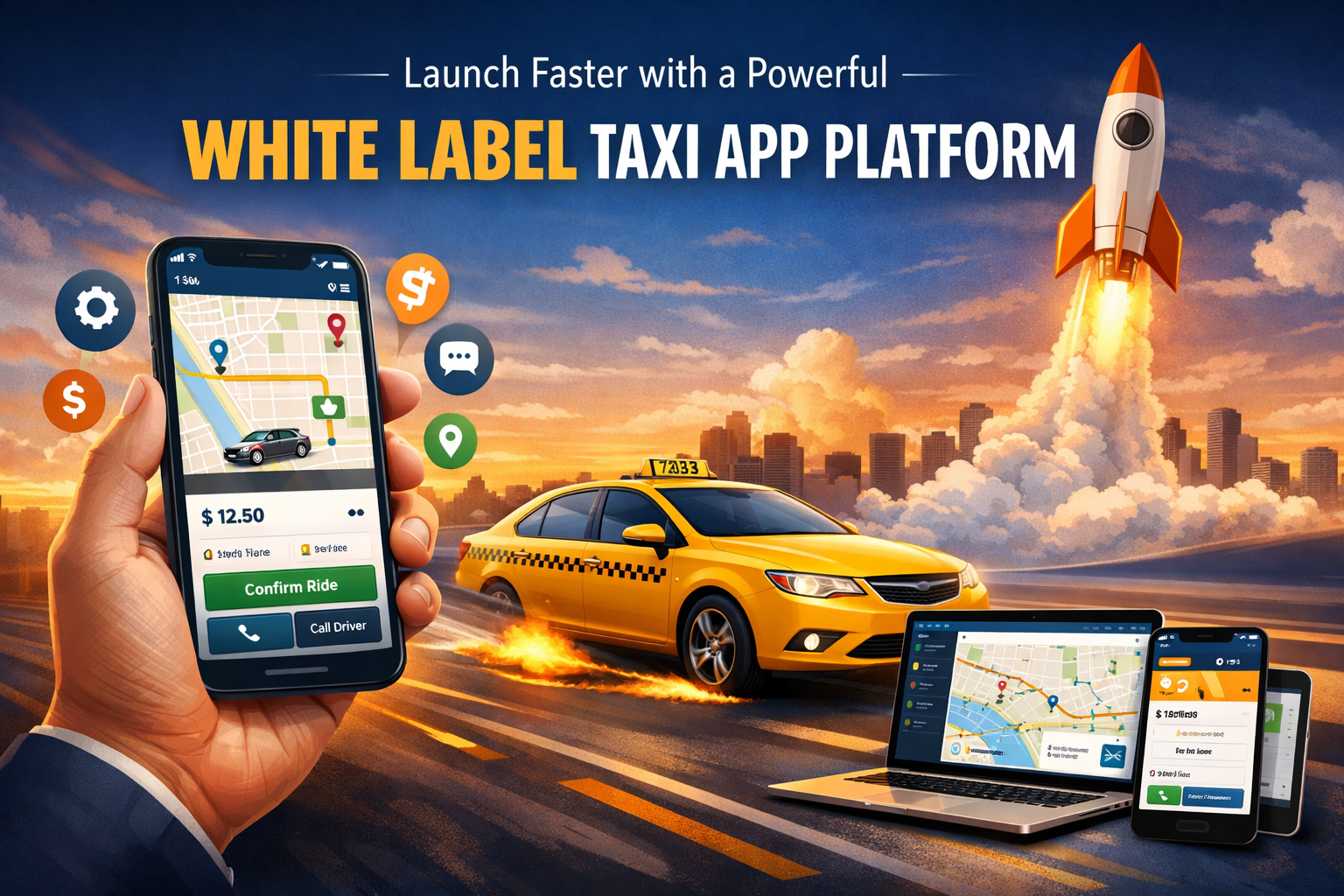
Starting a new transportation business today means more than a few cars and dispatch radio systems. Today, customers expect a hassle-free and smooth experience. In fact, features like booking a ride and tracking the driver with live updates have become the industry standard. As a result, if customers cannot pay using a saved card from the White Label Taxi app, they will quickly find competitors who offer these services instead.
While entrants to the market typically look like industry competitors, with big barriers to entry, like Amazon, instant funds from cos and large marketing teams, you can base your startup off of a pre-built software solution, and get your competition to the market first. Based on these barriers, therefore, you typically need large engineering teams and extensive funding to get the competition to the market first.
This is a white-label Taxi App solution to show you how to get the competition to the market first.
The Current State of the Ride-Hailing Market
Before diving into a project, looking at the data of the problems is always the best first step. As a result, the interaction of rapid urbanization and the decrease of personal vehicle ownership consequently leads to an increase in smartphone users needing reliable ride services. All of these things combined, leads to the ride-hailing and digital transportation market to increase.
The reports from market intelligence claim both 2025 and 2026 forecasting are estimations of accelerated growth considered to be both positive and rapid. As of 2024, the global market measured approximately USD 244 billion and by the decade’s end, it promises strong growth of 400 billion at an expected value of 9-11.7% at a compound rate.
MARKET INTELLIGENCE FOR RIDE-HAILING AND TAXI INDUSTRY.
| Year | Estimated Global Market Size (USD) | Key Growth Drivers |
|---|---|---|
| 2024 | $244 Billion | High vehicle ownership costs, return to office commuting |
| 2025 | $270 Billion | EV integration, corporate B2B ride contracts, AI routing |
| 2028 | $432 Billion | Continued urbanization, suburban and rural expansion |
| 2033 | $712 Billion | Subscription models, autonomous pilots, super-app ecosystems |
Profound expansion is anticipated which includes the possibility of new regional players. The local players are to adapt to local needs, integrate appropriate local technology and to be the most successful.
What is A White Label Taxi Booking App?
This is an app that is designed to be used by taxi booking companies. In fact, it is used to provide consumers digital access to taxi services and is tailored to the specifications of the taxi booking companies. Additionally, they furnish the option to customize under a logo of a taxi company, along with its color themes, proprietary pricing systems, and app features.
Instead of starting from scratch, you receive the following:
- Passenger App
- Driver App
- Admin Panel
- Dispatch System
- Payment Integration
Everything is built, tested, and ready for you to customize and launch.
This way, you save time, money, and minimize technical headaches.
Benefits of Choosing a White-Label Solutions for Your Taxi Company
Setting up a white-label solution for your taxi company as opposed to a custom-built solution has many positive business impacts.
Very Fast to Hit the Market: Unlike custom solutions that may take a year or more to complete, a white-label solution can be configured, branded, and be ready for your customers and start making you money in a few weeks.
You Save a Lot of Money: All the R&D costs of your solution have been paid for by your software company. Instead of a huge one-time software purchase that can take years to pay off, you just have a small monthly fee that is very predictable. As a result, this lets you take the money you didn’t spend on developing your solution and instead use it for advertising, driver procurement, and fleet control.
Reliability is Not an issue: In fact, white-label solutions have been used by many other companies worldwide. Therefore, this means other taxi companies have used the same software you will use. All the bugs have been found and fixed before you launch.
Your app provider should keep your app current with no effort on your side. Apple and Google change their processes every year. New security standards come out each year as well. Moreover, a good white label provider will keep the software up to date and ensure your app stays compliant with changes without you even having to request it.
Essential Elements of a Competitive Offering
Your app needs to be as good as Uber and Lyft. There are three components, and each one has a Passenger App, Driver App and a Back Office.
Driver App
This is your business, and if the app is bad, the drivers are going to leave.
Easy Sign Up
Drivers should be able to create a profile and sign up to drive as quickly as possible.
Easy Navigation and Fast Pick Up
Drivers should not have a hard time picking up a passenger.
Good Feedback Mechanism
Drivers should be able to provide feedback when they are not able to pick up passengers.
1. Passenger App
This is your business, and it is more important than the driver app.
- Easy Registration and Profile Management: In addition, users should be able to sign up quickly using their phone number, email, or social media accounts.
- Pick Up and Drop Off Locations: First, passengers should be able to choose their pick-up and drop-off locations.
- Know Before You Go: Passengers should see an estimated cost before they confirm the booking based on distance, time and demand. Transparency is critical.
- The Customer App Different Ride Choices: In fact, flexible budgets and personal preferences should dictate the type of ride users select. With options like economy, luxury, and larger vehicles for groups, therefore, users can use the app to request the ride of their choosing.
- Live Ride Tracking: After booking a ride, the app will then provide ride tracking, route tracking, and real-time ETA updates. Users will see the updates as the driver also moves.
- In-App Payments: Moreover, seamless payments are made possible by collaborations with major payment processors. Moreover, users can save multiple cards, and therefore, payments will auto process and occur without user action.
- Feedback: To ensure everyone is safe and to improve service, therefore, two-way ratings and reviews are a must.
2. The Driver App
Simplified and Optimized Your drivers are your business partners. Because of this, the app should be as user friendly as possible to enable navigation, conserve battery, and efficiently assist with real time traffic updates.
- Easy Onboarding: Drivers should be able to upload their insurance, registration, and license documentation through the app for admin approval.
- Status Management: The app should also include a manual online/offline switch to allow drivers to control their own hours.
- Dispatch and Ride Notifications: The system should provide real time notifications to drivers to ensure quick and efficient ride requests and notifications to the nearest driver relative to the passenger.
- In-app Navigation: Navigation integration allows drivers to get turn-by-turn directions without having to exit the app to use navigation apps.
- Driver’s Earnings: Dashboard’s every day and every week and every month driver’s earnings and completed trips and pending payments also motivate drivers.
3. The Admin Dispatch Panel
This is where it all comes together. It’s the online portal from which you and your team can run everything.
- Live Fleet Tracking: Get a real-time overview of all the active drivers, rides in progress and available vehicles.
- User and Driver Management: Ability to approve driver accounts, check documents, suspend users who breach the terms of service and manage support tickets.
- Dynamic Pricing Engine: Take control of your pricing. Balance supply and demand by setting a base fare, a per mile rate and surge pricing for peak hour, poor weather and special events.
- Promo Code and Discount Management: Run targeted marketing campaigns by offering discounts to new users or seasonal promotions to increase ridership.
Without analytics and reporting capabilities, access to data that allows for continuous improvement is impossible. Understanding driver revenue and popularity, peak usage times, and the data trends present in the admin panel would be invaluable to any taxi business.
Launching Your Taxi Booking App

Planning is required to start a taxi service like Uber. The steps that follow should be completed in the order that they appear.
Step 1. Know Your Target Market
- You should clarify the following questions:
- Which cities or countries?
- What focus, urban or suburban?
- What about a premium or budget ride offering?
- Are there any notable competitors on the same level as your business?
Step 2. Identify White-Label Providers
- Consider the following:
- Options available to personalize your brand.
- Continuous support with respect to any deployment issues.
- Payment security issues should be handled in a specific manner.
- Your business partner should provide you with the best possible experience in developing the taxi booking app.
Step 3. Customization of Your Application
You should modify the following features:
- Your brand insignia
- The theme of colors
- The description of your ride and the cost associated with it
- Skip any formatting issues to ensure that your application represents your brand.
Step 4. The Process of Driver Registration
Recruitment of trustworthy drivers should be completed. During the launch period, provide a prompt to quicken your growth.
Step 5. The Launch and Marketing
You should focus your advertising on the following social media platforms:
- Advertisements in social media.
- Referral systems.
- Collaborations with local businesses.
- Promotions of influencers.
A strong advertisement should be aimed at increasing the number of downloaded taxi applications.
Why is Starting a Taxi Business Now a Good Idea?
The transport sector is looking for the best possible offerings, and for good reason:
- The population in urbanized regions is on the rise. People living in cities require transport services on a daily basis.
- Smartphone Penetration .The billions of smartphone users represent a ready market for Taxi Apps.
- Flexible Work Model. Many drivers like gig-based work.Expansion Opportunities.
You can expand into:
- Corporate rides
- Delivery services
- Car rentals
- Bike taxis
- Your Taxi Service Like Uber can grow beyond rides.
Cost Breakdown of Taxi Booking App Development
Here’s a general cost comparison:
| Development Type | Estimated Cost | Time Required |
|---|---|---|
| Custom Development | $80,000 – $200,000 | 8–12 Months |
| White Label Solution | $10,000 – $40,000 | 2–6 Weeks |
White label Taxi Booking App Development saves both money and time.
Challenges in Taxi Apps and How to Overcome Them
Every Taxi Business faces challenges. Being prepared helps you to overcome the challenges.
- Driver Retention
- Flexible commissions and bonuses work best.
- Customer Trust
- Support and pricing transparency helps.
- Competition
- Customer service and dependability wins, especially in the local area.
- Regulatory Compliance
Know the transport laws in your area before you launch your application.
The more you plan, the more you reduce your risks.
The Future of Taxi Apps
Taxi Apps will continue to develop in areas like:
- Subscription based ride packages
- Voice-based bookings
- Testing of autonomous vehicles
- AI based route optimization
- Integrated Electric vehicles
- The way of the future is more technology-based, and those who utilize the most advanced technology will be the most competitive.
- Taxi apps of the future will be more efficient and cost effective.
- Those entrepreneurs who continue to modernize will remain competitive.
Why White Label Rather than Start from Scratch?
Starting from scratch might appear to be enticing, but in most cases, the cost of going to the start line is prohibitive. With a white label Taxi Booking App Development solution you get the following advantages:
- Speed
- Keeping costs in check
- Technical headaches will be diminished
- Functionalities are pre-built
- Instead of coding and debugging, you can concentrate on operation and growth.
Numerous Taxi Businesses that are now successful started by using ready-made systems, and then grew from there.

Final Thoughts
Building a modern day transport business does not require spending years, or millions on the development of software. With a quality white label solution, essentially, the only thing that you will require is to put in the effort to create your brand, recruit good drivers, and offer your passengers an excellent service. The market is large, and the demand is available. With the right software, first of all, a good local plan, and most importantly, a little bit of patience, you will be able to start and grow a digital mobility business that will eventually generate a good profit.


